Brain-Computer Interface (BCI) or
Brain-Machine Interface (BMI) is an interface
that converts signals generated from the brain into device control commands.
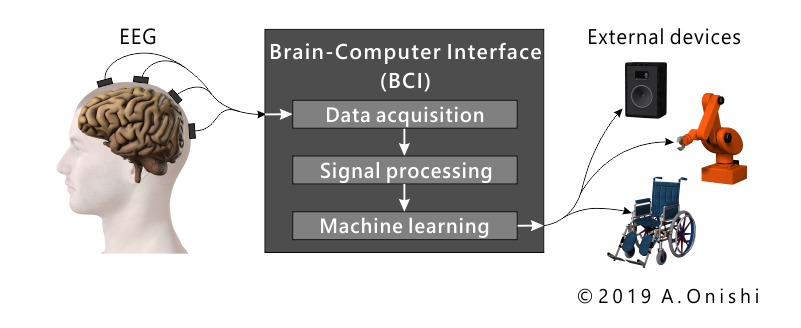
An example of BCI is shown in the figure.
A weak electrical signal is generated from the human brain,
which is called an electroencephalogram (EEG).
The BCI measures brain waves from electrodes attached
to the scalp and converts them into device control commands
by applying signal processing and machine learning.
For example, BCI can output commands to move the
wheelchair back and forth, left and right.
Furthermore, it can manipulate the robot arm and
can play synthesized-speech and music from the speakers.
In this way, you can operate assistive devices using brain waves by using BCI.
Even if we lose the function of limbs due to accidents or illnesses,
BCI can be an alternative pathway to control assistive
device and to communicate with others.
Therefore, BCI is expected to encourage
self-reliance and to improve the quality of life (QOL)
for, e.g., people with severe motor dysfunction.